


 English
 中文简体
 Français
How Does a Lotion Pump Work? Anatomy, Mechanics & Choosing the Best Pump Bottle
Content
It happens dozens of times a day, often without a second thought: a thumb presses down on a plastic pump, and a smooth ribbon of lotion appears. The gesture feels effortless, but beneath it sits a small piece of precision engineering that has been refined over decades. For anyone who formulates, fills, or sources beauty packaging, understanding how a lotion pump works is a useful first step toward choosing the right bottle — and avoiding the small frustrations of a pump that sputters, leaks, or stops halfway through the bottle.
The Anatomy of a Lotion Pump
Take a lotion pump apart and you will find the same handful of components doing their jobs in sequence. The exact design varies from one supplier to another, but the principle is remarkably consistent.
| Part | Role |
|---|---|
| Actuator | The button you press; its internal channel guides the product toward the nozzle. |
| Piston | Moves up and down inside the pump body and changes the volume of the chamber. |
| Spring | Pushes the piston back to its rest position after every press. |
| Ball valve | A one-way seal at the bottom of the chamber; product can enter, but it cannot flow back down. |
| Dip tube | A straw that reaches toward the bottom of the bottle and carries product up to the chamber. |
| Housing / closure | Holds the mechanism together and secures the pump to the neck of the bottle. |
Each part has a simple job, and the real magic happens when they work in rhythm.
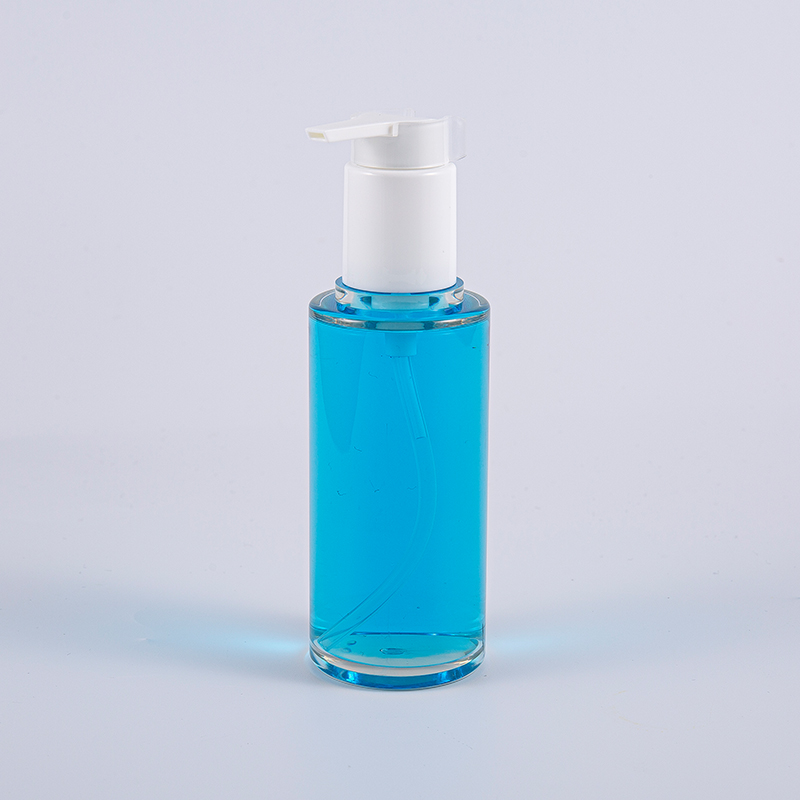 Clear PETG 100ml Round Lotion Bottle with White PumpThis thick-wall PETG bottle offers a premium feel and clear visibility, ideal for lotions and creams. Its compact 100ml size suits samples or travel-sized skincare lines.View Product →
How a Lotion Pump Works, Step by Step
Here is what happens from the moment your thumb goes down to the moment the pump is ready for its next dose.
- Press down. The actuator pushes the piston into the pump body and compresses the spring. The chamber shrinks, and the ball seals the inlet at the bottom, so the liquid already inside the chamber is forced up through the piston stem and out through the nozzle.
- Let go. The spring pushes the piston back up, expanding the chamber and creating a vacuum — a small drop in pressure inside the pump.
- The vacuum draws product upward. The pressure in the chamber is now lower than the pressure at the bottom of the dip tube, so the product is pushed up the tube. The ball lifts off its seat, and liquid flows into the chamber.
- The chamber refills. Once the chamber is full and the pressure equalizes, the ball settles back into place and seals the inlet again.
- The cycle repeats. On the next press, the freshly drawn product is forced out through the nozzle. After the first few priming presses, each stroke delivers a steady and consistent dose.
The whole system relies on a clean balance between the spring, the ball, and atmospheric pressure. If any one of them is off — a weak spring, a ball that does not seat properly, or a dip tube that does not reach the product — the rhythm breaks down and the pump begins to sputter.
Standard Lotion Pumps vs. Airless Pumps
Most bottles with a pump use the classic dip-tube design described above. There is, however, a second family worth knowing about: the airless pump. It works on similar pressure principles but changes one important detail — the relationship between the product and the air inside the bottle.
| Feature | Standard lotion pump | Airless pump |
|---|---|---|
| Draws product using | a dip tube inside the bottle | an inner bag or piston base moving upward |
| Air enters the bottle | Yes, to replace the product | No; the container collapses as product is used |
| Best suited for | Lotions, body washes, hand soaps, shampoos | Serums, active skincare, creams and thicker lotions |
| Product evacuation | A small amount of residue at the bottom | Nearly complete evacuation |
| Protection from air | Moderate | High, keeping oxygen away from the formula |
For simple formulas such as body lotion or hand wash, a standard pump is reliable and economical. For concentrated serums or preservative-free formulas, an airless design keeps oxygen away from the product, so it stays fresher for longer.
 Multi-Layer Translucent Matte Airless Bottle with PumpAirless technology keeps serums and preservative-free formulas fresh longer. Available in 100ml, 160ml, and 200ml, with a matte finish that elevates premium skincare packaging.View Product →
Choosing a Lotion Pump Bottle That Fits Your Product
When you source a pump bottle, the mechanism matters as much as the look. These are the main points we ask customers to consider before we make a sample.
- Viscosity. Thicker creams need a wider dip tube and a pump chamber designed for high-viscosity flow. A thin toner needs a smaller output so it does not gush.
- Neck finish. The pump has to match the bottle's thread, typically a standard closure size such as 24/410 or 28/410.
- Output per stroke. Pumps are rated by how much they dispense each time, so it helps to know how much product a single application needs.
- Material compatibility. The formula should not swell, soften, or corrode the plastic parts over time. PETG, PET, PE, and PP each behave differently.
- Travel and lock-up features. A twist-lock collar stops the pump from being pressed accidentally in luggage or during shipping.
- Sustainability expectations. Refillable bottles, replaceable inner bags, and recyclable materials are increasingly part of the conversation.
Getting these details right is the foundation of a good packaging decision. If you are comparing bottle shapes and materials, our lotion bottle guide walks through the most common options and how to match them to your formula.
 Soft Touch 250ml Cleansing Bottle with Plastic PumpA durable PE bottle designed for liquid soaps and cleansers, with a soft-touch finish. Pair it with various cap types to match your filling line and product needs.View Product →
What We've Learned in the Factory
As a manufacturer of plastic packaging, we see pumps from a slightly different angle. A bottle leaves our workshop, travels to a filling line, sits on a shelf, and eventually ends up in someone's bathroom cabinet. For it to work well all the way through, the pump and the bottle have to be a matched pair — the correct neck finish, the right dip tube length, a spring that responds smoothly, and a material that suits the product inside.
That is why we test pump bottles before they ship, checking that the pump seats evenly and primes quickly without leaking. It is also why we are glad to share what we know. If you would like to see how these principles come together in real packaging, take a look at our product catalog.
The next time a pump delivers exactly the right amount of cream, you will know what happened behind the plastic: a spring, a ball, and a quiet vacuum working in perfect sequence. It is a small detail in the world of packaging, but for product developers and brand owners, it is one of those details that makes a product feel genuinely well made.
PREV:No previous articleNEXT:how do foaming bottles work: Applications, Selection Criteria, and Practical Guidance
Interested in cooperation or have questions?
Subscribe to us and
get the latest updates.
get the latest updates.
Stay In Touch

Product Links
Contact Us
-
Phone: +86-13567569350
-
Tel: +86-575-82575298
-
Email: [email protected]
-
Add: No. 5 Plant, Zhejiang Tengxin New Energy Industrial Park, Daoxu Street, Shangyu District, Shaoxing City, Zhejiang Province, China.
-
South Korean company: 태미코스
Tel: 010-5617-6888
Add: 서울특별시 금천구 가산동 60-46 더리즌밸리 801호
Copyright © Shaoxing Lizhi Plastic Products Co., Ltd.