


 English
 中文简体
中文简体 Français
Body Lotion Plastic Bottle Guide: Materials, Pumps, Sizes, and Sourcing Tips
Content
A 200 ml body lotion built around shea butter and niacinamide can read beautifully on a formula sheet and still fail in the bathroom. The pattern is familiar to anyone who has launched one: the bottle looks right on the shelf, but the pump takes four or five strokes to prime, the last 20 ml refuses to come out, and within a month the reviews mention wasteful packaging instead of the lotion itself.
The root cause is rarely the formula. It is that the bottle was chosen as a shape instead of as a system. For body lotion, the plastic bottle determines how the product dispenses, how long sensitive ingredients stay stable, and what each filled unit actually costs. Work through material, capacity, and closure in that order, and decoration becomes the easy part. Here is how to make those decisions with realistic trade-offs attached to each one.
Start With the Resin, Not the Silhouette
High-density polyethylene (HDPE) is the default body lotion resin for good reason. It shrugs off the oils, emulsifiers, and fragrance loads typical of lotion, it molds into opaque or frosted finishes that hide fill lines, and it squeezes down cleanly as the product runs low. It is also the resin most household recycling streams recognize, which matters if you plan to print a recyclability claim anywhere near the label.
Body lotion also lives in shower caddies and on wet bathroom shelves, so grip and silhouette carry real weight. An ergonomic 200 ml PE bottle shaped for wet hands solves a problem a straight cylinder never will:
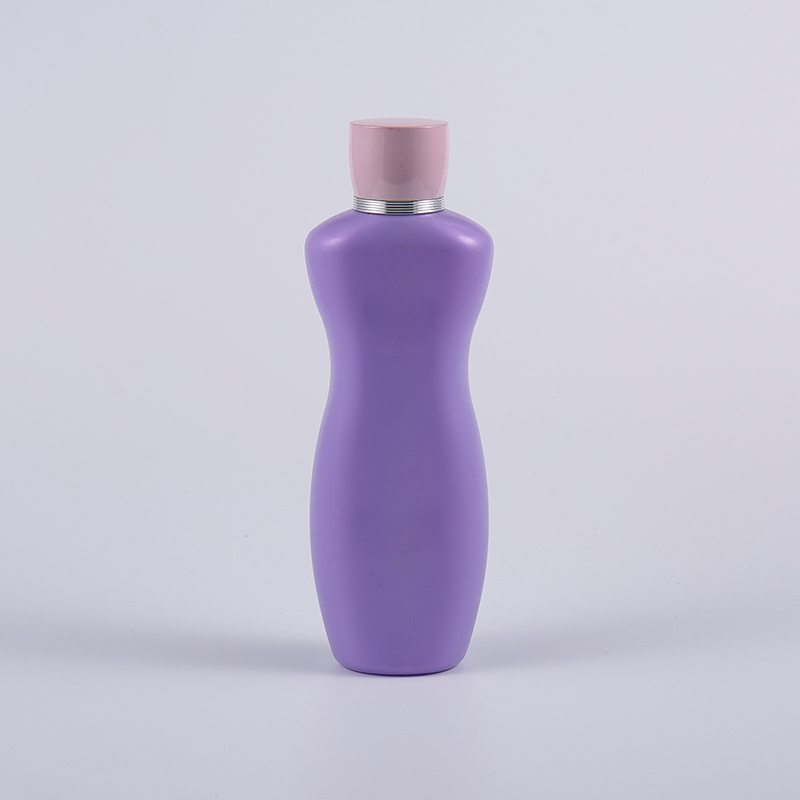 Pink Purple Ergonomic 200ml PE Body Lotion BottleThis 200ml PE bottle features an ergonomic shape for secure handling on wet bathroom shelves and in shower caddies, offering a durable, lightweight body for lotions and bath washes with flexible closure options.View Product →
Polyethylene terephthalate (PET) earns its place when clarity matters. A pearlescent or tinted lotion looks richer behind glossy, transparent walls, and PET holds its shape in upright pump formats. The check to run: high essential-oil concentrations can cause stress cracking in PET, so request chemical-compatibility data before you commit. PETG goes further for premium lines. Molded with thicker walls, it mimics the weight and optical depth of glass at a fraction of the shipping cost, which is why it appears so often in gift-positioned sets. Polypropylene (PP) plays a supporting role as the resin of choice for pump actuators and closures, since it resists formula chemistry and flexes without cracking.
For a closer look at the workhorse resin, our guide to choosing the right body lotion plastic bottle in HDPE covers wall thickness, neck finishes, and the supplier questions worth asking early.
| Material | Typical Look | Best Suited For | Check Before Ordering |
|---|---|---|---|
| HDPE / PE | Opaque or frosted, soft-touch friendly | Everyday 200-500 ml body lotion and family sizes | Decoration adhesion on frosted surfaces |
| PET | Clear and glossy | Tinted or pearlescent lotions in upright pump bottles | Stress-crack resistance with high essential-oil loads |
| PETG | Glass-like with thick walls | Premium and gift-positioned lotion lines | Higher resin cost per unit |
| PP | Translucent and lightweight | Pump actuators, closures, and some bottle bodies | Lower rigidity than PET in larger formats |
Capacity and Dispensing: Where Body Lotion Wins or Loses
Body lotion sits on a comfortable capacity ladder, and the rung you choose signals price positioning as much as it holds product.
A Practical Capacity Ladder
- 10-50 ml: sampling programs, gift-with-purchase offers, and travel kits
- 100-120 ml: travel retail and premium minis
- 180-250 ml: the core retail range, with 200 ml as the most common landing point
- 300-500 ml: family sizes that reward frequent users
- 720-1000 ml: salon, hotel, and refill-economy formats
Pump, Disk Cap, or Flip Top
Dispensing is where most customer complaints originate. A standard lotion pump releases roughly 1 to 2 ml per stroke, but that number means nothing if the pump cannot prime in a thick formula. Rich, buttery lotions need a wider orifice and a stronger spring return; a dip tube cut for a watery toner will leave you with an airlock and a bad review. Disk caps and flip tops cost less per unit and work well for fluid formulas, but they push the user to squeeze, which turns messy once viscosity climbs.
Matte white finishes are a quiet workhorse at the 200 ml mark: they hide fingerprints and fill-level shadows on the shelf while keeping a premium, calm appearance:
 200ml Multi-Layer Matte White Lotion Bottle for Body SkincareA matte white multi-layer PE bottle at 200ml that hides fingerprints and fill-level shadows while helping protect active ingredients like niacinamide and vitamin C from light and air exposure.View Product →
Barrier Options When the Formula Carries Actives
Body lotion is no longer just occlusion and fragrance. Niacinamide, vitamin C derivatives, and retinoids now appear in products marketed for the body, and these ingredients degrade on contact with air and light. A single-layer bottle leaves a headspace of oxygen above every pump stroke, and over a six-month bathroom lifespan that exposure can shift both color and performance.
Two structures address the problem. Multilayer composite bottles sandwich barrier layers between the inner and outer walls, slowing oxygen transmission from the outside in. Inner-bag vacuum bottles go further: the formula sits in a collapsible bag, and each pump stroke pulls the bag inward, so air never replaces the product that leaves. The trade-offs are honest ones, namely a higher unit cost and one more assembly step at filling, but for an active-rich premium lotion that premium is usually cheaper than a reformulation. We explain the mechanics in more depth in our breakdown of how multilayer lotion bottles enhance product freshness and shelf life.
For brands testing the airless format, a mid-size container built for lotions bridges the gap between facial sizes and full body formats:
 150ml Airless Cosmetic Container for Lotions and SkincareThis refillable 150ml airless bottle uses a vacuum design to limit oxidation, dispense nearly all product, and keep sensitive body lotion formulations hygienic between uses.View Product →
Sustainability Signals That Survive Scrutiny
Consumer forums and buying guides are full of shoppers hunting for plastic-free lotion, and that sentiment reaches your category whether you engage with it or not. Abandoning plastic rarely survives contact with logistics: glass breaks, costs more to ship, and often carries a heavier footprint overall. The durable answer is plastic that is easier to justify.
- Mono-material construction: an all-PE bottle paired with an all-PE cap is easier for recycling facilities to process than a mixed-resin set
- Refill formats: an inner-bag vacuum shell kept by the customer and repurchased as replacement bags cuts plastic per use substantially
- Lightweighting: trimming wall thickness where rigidity allows lowers resin use and freight cost at the same time
- Honest claims: "widely recyclable" should reflect what local facilities actually accept, since a pump with a metal spring is still a contaminant in many streams
Brands that pair a recyclable bottle with a credible refill story give sustainability-minded shoppers a reason to stay, without sacrificing the pump performance that makes body lotion pleasant to use.
Checks to Run Before Signing a Supply Agreement
Most packaging failures are visible in the first sample round if you know where to look. Run these checks before committing to a production order:
- Fill and age samples for 8 to 12 weeks at room temperature and at elevated temperature, then check for discoloration, odor transfer, and viscosity drift.
- Prime and stroke the pump at least 50 times; output should stay consistent and drip-back minimal.
- Drop-test filled, capped units from about one meter onto a hard surface; threads and pump collars fail first.
- Audit the neck finish: confirm the bottle specification, such as a 24/410 finish, matches the pump exactly, because mismatched bottle and pump suppliers are where most leaking starts.
- Age the decoration: expose soft-touch coatings and metallic inks to humidity, then rub and tape-test the surfaces.
- Pressure-test the terms: minimum order quantities, sampling lead time, and whether the factory can handle rapid proofing when you need a custom shape.
A manufacturer that keeps design, sampling, molding, and assembly under one roof removes the handoffs, and the finger-pointing that comes with them, from your critical path.
Body lotion rewards packaging decisions made in the right order: resin matched to the formula, a capacity that signals your price tier, a closure proven against your viscosity, and barrier structure only where actives justify the cost. A 200 ml bottle with a well-matched pump remains the category's workhorse for a reason: it dispenses reliably, ships economically, and recycles easily. Test those fundamentals early, and the decoration choices that make the bottle distinctly yours become the enjoyable part of the project.
PREV:No previous articleNEXT:PET Plastic Bottle Guide: Choosing Cosmetic Plastic Bottles for Your Brand
Interested in cooperation or have questions?
Subscribe to us and
get the latest updates.
get the latest updates.
Stay In Touch

Product Links
Contact Us
-
Phone: +86-13567569350
-
Tel: +86-575-82575298
-
Email: [email protected]
-
Add: No. 5 Plant, Zhejiang Tengxin New Energy Industrial Park, Daoxu Street, Shangyu District, Shaoxing City, Zhejiang Province, China.
Copyright © Shaoxing Lizhi Plastic Products Co., Ltd.