


 English
 中文简体
中文简体 Français
How Do Airless Pump Bottles Work? A Packaging Insider's Guide for Brands
Content
- 1 What Makes an Airless Pump Bottle Different
- 2 Inside an Airless Bottle: The Parts That Do the Work
- 3 How the Dispensing Cycle Actually Works
- 4 Airless and Standard Pump Bottles Side by Side
- 5 Why This Matters for Formula Performance
- 6 Choosing the Right Airless Bottle for Your Product
- 7 Questions Brands Ask Us Most
Airless pump bottles have quietly become the default package for serums, vitamin C formulas, retinoids and anything else that spoils when it meets the air. If you have ever pressed the top of one and felt a firm, slightly springy stroke instead of a soft squirt, you have already met the mechanism at work. There is no dip tube inside, and nothing that comes out ever goes back in.
We build these bottles every day in our own workshop, so this guide walks through what happens inside an airless bottle stroke by stroke, and explains what that means when you are specifying packaging for a new formula.
What Makes an Airless Pump Bottle Different
A conventional lotion bottle works on a simple principle. You press or squeeze, product travels up a dip tube, and air is drawn back into the bottle to replace the volume you removed. That returning air is the problem. It carries oxygen, and often bacteria, into direct contact with the formula, gradually oxidising the active ingredients you paid good money for and changing the texture of the product as the bottle empties.
An airless bottle removes two things at once: the dip tube and the air. The product sits directly above a piston, or inside a flexible inner bag, and the pump draws from the lowest point of the reservoir. Every stroke removes a small, measured amount. As the product leaves, the piston or the bag moves up to follow it, so the remaining formula stays in contact with the pump inlet and never with the outside air.
Think of it as a small vacuum chamber that shrinks as it empties. The vacuum is what does the work, not gravity, which is why an airless bottle still dispenses perfectly well when you store it upside down in a travel bag.
Inside an Airless Bottle: The Parts That Do the Work
Most airless bottles are built from six or seven components, and each one exists for a specific reason.
- Pump head, also called the actuator: the button you press. It houses the metering chamber and the outlet valve, and its internal geometry determines the dose size.
- Inlet and outlet valves: two one-way valves that let product travel in one direction only. They are the reason nothing can flow backwards and air cannot seep in.
- Piston or follower plate: a disc that sits directly beneath the product and rises as the bottle empties. This is the classic rigid-wall airless design.
- Inner bag: a flexible pouch that holds the formula and collapses as it empties. Air is allowed into the gap between the bag and the bottle wall, so no piston is needed and the bottle can be used in almost any orientation.
- Bottle body: usually PETG, PET, PE or PP. Multilayer structures with an EVOH barrier layer are common where the formula is especially oxygen sensitive.
- Base vent: a tiny hole in the base that lets air in below the piston so it can travel upwards. It is normally hidden by the label or the base rim, and it never touches the product.
- Overcap: transit protection, and often the surface that carries your decoration and branding.
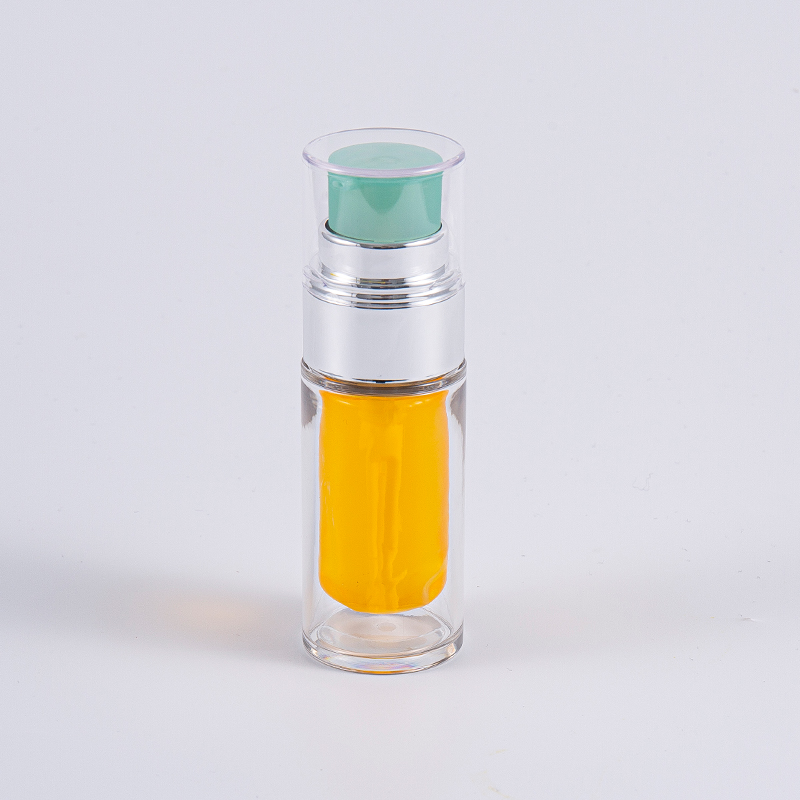 Clear PETG Airless Bottle with Multi-Layer Inner BagAvailable in 30ml and 50ml, this clear PETG vacuum bottle uses a multi-layer inner bag to protect air-sensitive formulas and compare bag-in-bottle construction.View Product →
The bag-in-bottle version above is a good example of how the two families differ. A piston bottle uses a rigid wall to hold its shape; a bag-in-bottle design keeps the outer shell for structure and lets the flexible inner bag do the collapsing, which is why it can be filled and emptied from almost any angle.
How the Dispensing Cycle Actually Works
Follow one press of the actuator from start to finish and the whole system becomes easy to picture.
- You press the pump head, and the metering chamber inside compresses.
- The outlet valve opens, and a fixed dose leaves the nozzle. Common doses run from 0.2 ml to 0.5 ml per stroke, with larger outputs available for body care.
- You release. An internal spring returns the pump head to its rest position, and the outlet valve closes behind it.
- The chamber expands again, which creates suction at the bottom of the reservoir.
- That suction pulls formula through the inlet valve and refills the metering chamber, ready for the next press.
- Because a small volume has left the reservoir, the piston or inner bag moves up by exactly that amount. Air enters through the base vent to fill the space behind the piston, but it stays on the outside of the product at all times.
Two practical details follow from this. First, an airless bottle needs priming: three to five presses before a new unit delivers a full dose, which is normal and not a fault. Second, because every stroke is metered, output stays consistent from the first press to the last, even when the bottle is nearly empty.
Airless and Standard Pump Bottles Side by Side
The table below sums up the differences we see most often in brand briefs and lab comparisons.
| Feature | Standard dip-tube pump | Airless pump bottle |
|---|---|---|
| Air contact with formula | Air returns after every stroke | Product never meets outside air |
| Dose consistency | Drops off as the bottle empties | Steady from first press to last |
| Product left behind | Often 5 to 10 percent unreachable | Usually under 5 percent |
| Viscosity range | Thin to medium | Thin through to heavy creams |
| Preservative strategy | Normally full preservation needed | Often allows a lower preservative load |
| Unit cost and filling | Lower cost, simpler filling | Higher unit cost, tighter process control |
Why This Matters for Formula Performance
Oxidation is the first benefit most formulators mention. Vitamin C, retinol, peptides and plant oils all react with oxygen, and in a dip-tube bottle they are exposed to fresh air with every single use. Sealing the formula behind a piston slows that process considerably, which is often the difference between a product that looks fresh after twelve months and one that has turned brown in the warehouse.
Hygiene is the second. Because nothing flows back into the reservoir, a finger, a spatula or a splash of water in the bathroom cannot contaminate what is left in the bottle. Many brands use this to justify a leaner preservative system, although the choice always belongs with your own microbiologist.
Waste is the third, and it is more commercially important than it sounds. A well-made airless bottle empties to within a few percent of its fill volume. That means a 30 ml claim delivers close to a genuine 30 ml of usable product, and the consumer's last week of use feels the same as the first. If you want to go deeper on the technical side, we wrote a full breakdown of how inner bag vacuum bottles keep formulas fresh that covers barrier layers, filling and shelf-life testing.
Choosing the Right Airless Bottle for Your Product
Once you have decided that airless is the right route, the specification work begins. These are the variables that shape a project most.
- Capacity and dose: 15 ml to 50 ml suits eye creams, serums and treatments, while 100 ml to 200 ml is more common for body lotion and cleansers. Match the dose to how long the product should last, not just to the fill volume.
- Viscosity: thin toners and watery essences need a tighter valve and a smaller chamber than rich creams. Always test with the real formula, not with water.
- Material and appearance: PETG gives a clear, glass-like wall that suits premium skincare, while PE and PP are cost-effective for larger wash-off formats. Multilayer structures add barrier performance.<//li>
- Delivery system: choose a rigid piston bottle when you want a substantial, heavy feel, and a bag-in-bottle design when refillability or full-angle dispensing matters more.
- Decoration: spray coating, silk screening, hot stamping and metallisation all work on airless bottles, but confirm the sequence with your supplier early, because some finishes cannot be applied after assembly.
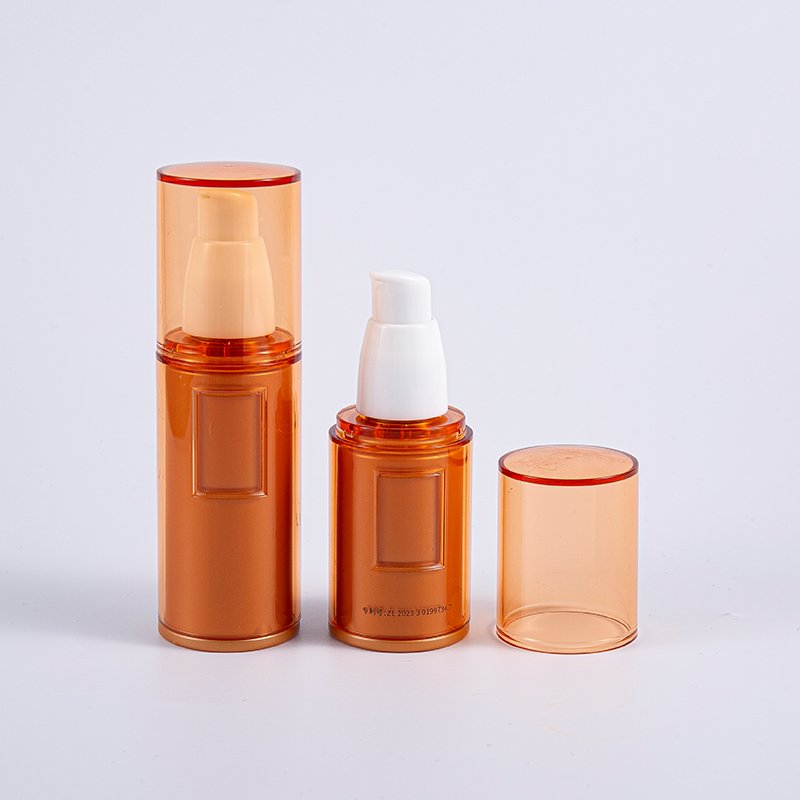 Refillable 40ml Inner Bag Vacuum Bottle with Airless PumpThis 40ml PP refillable airless bottle uses an inner bag for near-complete dispensing and suits sensitive skincare, while cartridge swaps reduce plastic waste.View Product →
Refillable designs are increasingly requested by brands with a sustainability commitment, and they are simpler than they look: the outer shell and pump stay with the consumer, while a replacement inner bag or cartridge is swapped in.
 100ml Refillable Inner Bag Vacuum Bottle for LotionsThis 100ml PP airless container uses a refillable inner bag to protect lotions and skincare from oxidation, with near-complete dispensing for larger body-care formats.View Product →
Larger capacities open up body care and cleansing formats, where the same airless principle protects actives and delivers a controlled dose every morning.
Questions Brands Ask Us Most
Do airless bottles work with thick creams?
Yes, and this is where they outperform dip tubes most clearly. A rigid, highly viscous cream tends to sit at the bottom of a conventional bottle and never reach the tube. The piston in an airless bottle pushes the whole mass upwards, so texture has far less influence on how completely the pack empties.
Can an airless bottle be refilled?
The outer shell and pump head can be reused many times, but the inner bag or piston chamber is the part that is replaced. Refilling a sealed airless reservoir by hand usually breaks the vacuum and the unit will not dispense reliably afterwards, so a cartridge swap is the practical route.
Why does my sample sometimes fail to prime?
Almost always because the pump chamber is still full of air from assembly. Five firm, unhurried presses normally clears it. If a unit still will not prime after that, the cause is usually over-filling, a mismatched valve, or formula that has thickened in the nozzle.
Airless packaging rewards a little planning up front. Get the dose, the viscosity match and the filling process right, and the mechanism is almost invisible to the consumer: the bottle simply works, every day, until it is empty. That quiet reliability is exactly what keeps a formula and a brand promise intact on the shelf.
If you would like to talk through a bottle for a specific formula, our team is always happy to look at your fill volume, viscosity and timeline, and to send samples you can test with the real product. You are welcome to browse our full cosmetic packaging range or send us your brief directly.
PREV:No previous articleNEXT:How Can We Make Plastic Bottles? A Manufacturer's Guide to Bottle Production
Interested in cooperation or have questions?
Subscribe to us and
get the latest updates.
get the latest updates.
Stay In Touch

Product Links
Contact Us
-
Phone: +86-13567569350
-
Tel: +86-575-82575298
-
Email: [email protected]
-
Add: No. 5 Plant, Zhejiang Tengxin New Energy Industrial Park, Daoxu Street, Shangyu District, Shaoxing City, Zhejiang Province, China.
-
South Korean company: 태미코스
Tel: 010-5617-6888
Add: 서울특별시 금천구 가산동 60-46 더리즌밸리 801호
Copyright © Shaoxing Lizhi Plastic Products Co., Ltd.